
Green Pay/Reward Techniques and Corporate Non-Financial Performance: A Case Study of South-West, Nigeria Deposit Money Banks
Sule Olatunji Eniola*  , Oshi Joseph E. O and Alagah Drusilia Adekemi
1Management Department, University of Port Harcourt, Port Harcourt Nigeria .
http://dx.doi.org/10.12944/JBSFM.05.01.02
Copy the following to cite this article:
Eniola S. O, Joseph E. O. O, Adekemi A. D. "Green Pay/Reward Techniques and Corporate Non-Financial Performance: A Case Study of South-West, Nigeria Deposit Money Banks". Journal of Business Strategy Finance and Management, 5(1).
DOI:http://dx.doi.org/10.12944/JBSFM.05.01.02
Copy the following to cite this URL:
Eniola S. O, Joseph E. O. O, Adekemi A. D. "Green Pay/Reward Techniques and Corporate Non-Financial Performance: A Case Study of South-West, Nigeria Deposit Money Banks". Journal of Business Strategy Finance and Management, 5(1). Available here: https://bit.ly/3D61MZg
Download article (pdf) Citation Manager Publish History



Introduction
Apart from achieving long term objectives of organisations, nonfinancial performance assist in the modification of the behaviour of the workforce because it makes it very glaring to each and every worker that their actions and inactions is a pointer to the well being of the firm (Yuliansyah & Razimi, 2015). Abernethy, et al. (2013) as cited in Yuliansyah and Razimi (2015) added that nonfinancial performance great help to capture broadly the performance of the firms. It was argued that while some organisations are not doing well, and some are performing excellently by relying on non-financial performance measures that are subjective and at the same time objective in nature (Van der Stede, 2006 as quoted in Ahmad & Zabri, 2016a).
Green human resource management came into limelight in 1990s according to Krithika, DivyaPriyadharshini and GokulaPriya (2019) revealed that green human resource management became a known concept in the 90s though it was widely embraced in the early millennium years. Sule and Onuoha (2020) established that it was part of the solution to the worldwide ozone layer depletion to apply a revolution of making everything green, that is, trying to be more friendly to our environment in all we do. As such, with human resource management practices (HRMP) that intends to be friendly with the environment was then referred to as green human resource management practices (GHRMP). The practices still remain the same, only that it is practiced with the concept of being envronmental friendly.
One of the GHRMP is green pay and reward systems which are important instruments in recruiting, retaining, motivating and rewarding the workforce for carrying out those responsibilities assigned to the workers. Though, the green compensation would have been all encompassing than green pay and reward systems but still many scholars prefer referring to it as green pay and reward systems, so we have to tare along with them as long as both terms could be used interchangeably. Amah (2016) added that pay is very crucial to compete in any industry an organisation belongs to. Ahmad (2015) also added that it is a very important link to bond employees with their employer. Green pay and reward systems of most formal organisations in this country include wage and/or salary though there are some other incentives payment embedded in both wage and salary; in the name of allowances, bonuses, and others.
Different scholars had tried to examine the relationship between GHRMP and CNFP (corporate non-financial performance) and or efficiency of firms but not many had actually examine the effect of a specific GHRMP on CNFP like Amah (2014) that looked at the efficiency and effectiveness of banks and its workforce and Sule and Onuoha (2020) that looked at performance without specifying which kind of performance. This study therefore, intends to bridge the gap in literature in that aspect by looking at the effect of green pay/rewards technique on CNFP and specifically, examining that with a particular reference to an important sector to every nations economy – the deposit money banks.
AIM
This study aimed at determining the relatedness of deposit money banks’ green pay/reward techniques and CNFP in Nigeria, South-West.
Objectives
- Evaluating the bond between deposit money banks’ green pay/reward techniques and employee satisfaction in Nigeria South-West.
- Establishing the association between deposit money banks’ green pay/reward techniques and operational efficiency in Nigeria South-West.
- Assessing the connexion between deposit money banks’ green pay/reward techniques and innovation in Nigeria South-West.
- What is the association between deposit money banks’ green pay/reward techniques and employee satisfaction in Nigeria South-West?
- What is the connection between deposit money banks’ green pay/reward techniques and operational efficiency in Nigeria South-West?
- What is the connexion between deposit money banks’ green pay/reward techniques and innovation in Nigeria South-West?
HYPOTHESES
All the three hypotheses are in null form:
- No association between deposit money banks’ green pay/reward techniques and employee satisfaction in Nigeria South-West.
- No connection between deposit money banks’ green pay/reward techniques and operational efficiency in Nigeria South-West.
- No connexion between deposit money banks’ green pay/reward techniques and innovation in Nigeria South-West.
Review of Literature
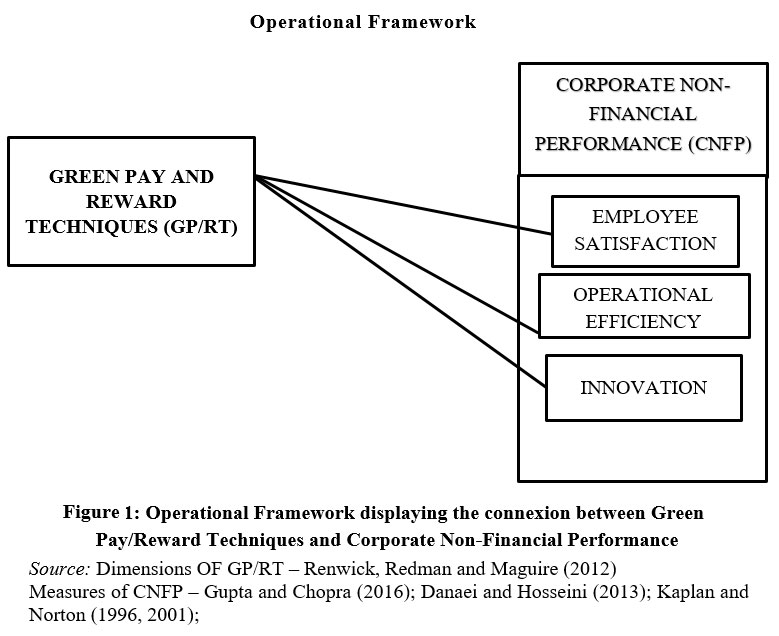 |
Figure 1: Operational Framework displaying the connexion between Green Pay/Reward Techniques and Corporate Non-Financial Performance Click here to view Figure |
Source: Dimensions OF GP/RT – Renwick, Redman and Maguire (2012)
Measures of CNFP – Gupta and Chopra (2016); Danaei and Hosseini (2013); Kaplan and Norton (1996, 2001);
Baseline Theory
Resource Based Theory
This theory emphasised how best to enjoy the maximum level performance as well as having something that other competitors cannot easily acquire. Though, at the advent of strategy as an aspect of management, most strategists had relied strongly on SWOT (strength, weakness, opportunity and threat) analysis to analyse every organisation until resource based theory/view came into being.
This theory specifically tries to identify a special tool for being ahead of the competitors in the industry with industry-environment focus (Onuoha, 2015). Barney (1991) in Olanipekun, Abioro, Akanni, Arulogun and Rabiu (2015) opined that this theory teaches any organisation that intends to have an upper hand over its competitors should have a particular resource that must not be easily accessible by competitors as per being rare and cannot be replicated but upon it all, it must be valuable. Onuoha (2016) asserted that resource based theory is an organisation’s view of analysing method and identifying an organisation’s competitive and strategic advantages with the examination of its distinct and separate assets and other capabilities combination.
Green Pay/Reward Techniques Concept
Another feature of GHRP is green pay and reward systems which are important instruments in recruiting, retaining, motivating and rewarding the workforce for carrying out those responsibilities assigned to the workers. Though, the green compensation would have been all encompassing than green pay and reward systems but still many scholars prefer referring to it as green pay and reward systems, so we have to tare along with them as long as both terms could be used interchangeably. Amah (2016) added that pay is very crucial to compete in any industry an organisation belongs to. Ahmad (2015) also added that it is a very important link to bond employees with their employer. Pay and reward systems of most formal organisations in this country include wage and/or salary though there are some other incentives payment embedded in both wage and salary; in the name of allowances, bonuses, and others.
Wage is the money paid hourly or daily or weekly for any manual employees usually in production and maintenance section of organisation. It is otherwise known as blue collar job and it is usually paid according to the unit of product produced by the worker or based on the number of hours worked called piece rate, this is why they are paid for those numbers of days they worked (Amah, 2016).
Also, salary paid work is referred to as white collar job or administrative/managerial work. It is normally paid on the yearly basis but paid monthly or fortnightly to the employee. It can then be defined as a fixed sum of money paid to staff monthly or fortnightly. Essien (2002) in Sule, Amuni, Obasan and Banjo (2015) opined that it is an annual fixed sum that is paid to the workers monthly. It is being paid based on the skill, knowledge and other special competency of the worker and because of these facts, many fringe benefits and incentives are attached to the salary like accommodation, company cars and others Amah (2016). Before the advent of green pay and reward systems, salaries of workers are paid only to the worker by queuing to collect it physical but now it is paid without seeing the staff especially in Nigeria of today through bank transfer. Again, they are entitled to some days off work to relax usually tagged annual leave and this comes with pay unlike wage workers. Essien (2002) in Sule, Amuni, Obasan and Banjo (2015) added that most salaried employees come together as union to negotiate their salary structures and it comes with increment annually.
Green pay and reward systems takes large part of most organisations’ running costs. Essien (2002) in Sule, et al. (2015) asserted that compensation generally consume about sixty-five percent (65%) of the firm’s operating/running cost. As such, green compensation is something that gives firms both private and public, big or small so many sleepless nights even as one is being paid, they are already thinking of where the next one will comes from. This is because pay and reward systems possess the power to influence recruiting, intention to stay/retention, job satisfaction, skills, knowledge disposition and many other valuable aspects of the workforce talking about their attitudes and behaviours Amah (2016). Green pay was described as the corporate goals and objectives attainment tool (Milliman & Clair, 1996 in Chowdbury, Roy, Arafin & Siddiquee, 2019).
Quoting section 7 of 1946 Labour Code of Nigeria, Sule, et al. (2015) emphasized that pay and reward system is made mandatory for every organisation to pay based on the contractual agreement they enter into with their employer to offer their individual endowment for a pay at an agreed period. Such payment according to Sule, et al. (2015) must be paid in the legal tender agreed upon at the time of the agreement was dully signed by both parties. It was deposited by Likhitker and Verma (2017) that it is important if not mandatory to compensate every employee especially those that acquire new skill and knowledge that can be used to invent new things. This will enable such employee to apply the new skill to accomplish his/her assigned task in the organisation and propel his/her job satisfaction. Ahmad (2015) and Alharbi (2020) submitted that green pay and rewards are essential way of rewarding employees for their performance and that pay and rewards are link agent of employee’s interest and the organisation’s interest.
They went further to support the assertion that ordinary recognition and even praise in any form will serve as non-monetary compensation and that such increases employees loyalty and retention of talents (motivation) and encourage awareness in the organisation. Green pay and loyalty are the main tools with which employees’ interest could be aroused in striving to attain the organisation’s goals and objectives. Pham, Tuckova and Phan (2019); and Chowdbury, et al. (2019) liken green reward to motivation in the AMO theory and that it is an extrinsic motivator that instigate positive intrinsic motivations like task accomplishment, knowledge sharing, skills improvement and work satisfaction.
Green pay and reward systems include both financial and non-financial; financial are those that are monetary payment while non-financial are those services enjoyed by the employees either provided or paid for by their employer like insurance, subsidized housing/accommodation, special leave, transportation, health facility gifts for the employee and the family and others (Tang, Chen, Jiang, Paille & Jia, 2018). Aburahma, Abu Amuna and Aqei (2020) classified green pay as monetary and non-monetary. Monetary rewards are those financial rewards while non-monetary rewards are those non-financial rewards as submitted by Tang, et al. (2018).
These are basically to attract, retain and motivate their workers in order to stay and contribute their best for the attainment of the employer’s goal and objectives according to Tang, et al. (2018) and Alharbi (2020). Ahamed (2012) in Chowdbury, et al. (2018) recommended green pay as an essential tool in making the Bangladesh bank staff to adopt properly, be proactive and mobilize them to perform better. Chowdbury, et al. (2019) citing Ramus (2002) also asserted that green pay and reward systems is a motivating factor that mould employee’s attitude and behaviour, and by implication determine the employee satisfaction level. Also, relying on Forman and Jorgensen, 2001, Crowdbury, et al. (2019) noted that pay and reward systems (that is, compensation) ginger employees to accomplishment of task and responsibilities very serious to the point of inventing and ensuring operational efficiency.
Again, relying on Jabbour and Jabbour (2016), Aburahma, Abu Amuna and Aqei (2020) opined that environmentally pay as well as reward systems are supporting tools for innovations and development of new products. Employees that are not satisfied with their job cannot think of developing any new idea or product. This means that there cannot be innovation, and operational efficiency will be minimal and skills that are not thoroughly used become obsolete. Krithika, DivyaPriyadharshini and GokulaPriya (2019) and Aburahma, Abu Amuna and Aqei (2020) went further to submit that green pay should be specifically used to gain green skills and knowledge for better things like innovation by workers. Krithika, DivyaPriyadharshini and GokulaPriya (2019) also asserted that green pay possess long term effect on both the employees and employer in terms of morale (employee satisfaction), innovation as a result of extra commitment and interpersonal relationship and operational efficiency because of the interest in ones’ job/organisation and availability of fund. It must be noted that pay must be in tandem with skill and knowledge possessed by the employee and his/her performance (Sule and Onuoha, 2020).
It is the only means of rewarding the performing staff according to Abrahma, Amuna and Aqei (2020). Tang, et al. (2018) quoting Jackson and Seo (2010) came up with a suggestion that pay and reward systems possess strong power to align workers’ performance with the organisation’s goals and GHRM practices.
Some of the goals expected of green pay and reward systems to achieve according to Amah (2016) include motivating employees to optimum job performance, reduction of employees’ voluntary labour turnover, employee satisfaction increment, encourage innovation and operational efficiency increase and many more. Again, with green pay and reward systems (compensation) workers are paid their due payment through technological system and they receive it almost immediately. This has greatly reduce the hazardous events like loss of life on the queue (especially, for pensioners who are of old age), robbing the employee of the pay on his/her way back home, loss of man hours by both employees and employer and many more. There is no gain saying that with all these, workers interest in the organisation will greatly be affected positively as such, employee satisfaction can be assured, innovation is guaranteed, operation efficiency for the organisation would not be a problem as the status of stakeholders and employees is activated with green pay and reward system. Finally, in such organisation, workers interpersonal relationship level is most likely to be impacted which can equally necessitated innovation and operational efficiency.
Non-Financial Corporate Performance Concept
The proposal of ability-motivation-opportunities theory on the green human resource management practices that it is an enhancer of the human capital of the organisation through staff capabilities and skills increment that will eventually translate into overall performance and higher productivity (Krithika, DivyaPriyadharshini & GokulaPriya, 2019). Those attributes are specifically those of the non-financial performance measures. The implication of this is that ability of an employee can serve as a motivator to search and even create opportunities to develop and grow the organisation as well. With AMO theory assumptions, the basis for measuring performance through non-financial indicators is suitable and in line with the assumptions.
It was contended by Kaplan and Norton (2008) as well as Wiersma (2006) in Kotane and Kuzmina-Merlino (2012) that non-financial performance indicators are the best tools to measure performance as it is future-oriented than the financial performance and that non-financial performance measures is impacting on the current and future managerial activities. Simons (1995) in Yuliansyah and Razimi (2015) opined that NFPM serves as enhancer of communication amongst members of organisation.
Employee Satisfaction
In Sule and Omoankhanlen (2018), Robins and Judge (2013) opined that satisfaction either with the job or by the employee include any constructive feeling and or job attitude that arises out of the work itself through evaluation of certain features of the job. Job satisfactioncould be described as a reflection of additional effort and unusual attitude relating to job. Sule and Omoankhanlen (2018) added that personnel working in favourable environment will not be able to distinguish between work and leisure just greeny environment will definitely attract positive mood on the job itenary resulting in not only better but improved performance. It was argued by Locke (1969) in Carmeli and Freund (2004) that Employee satisfaction entails an encouragment of passionate state that will result from employee’s job evaluation and job-related targets; and be it employee dissatisfaction or satisfaction, it is expected to be an complicated avid reaction to personnel’s work.
GHMP are sauce of job satisfaction of personnel in our firms (Ahmad, 2015; Chowdhury, Roy, Arafin & Siddiquee, 2019). Such situation usually arises as firms decided to enjoin greeny in its environment which will in turn encourage healthy vicissitudes both internal and external environments of the company. Such change, most time, are pleasant to the employees because going green always come into being via the robbing together of the employees’ and employer’s mind. Chowdhury, et al. (2019) opined that if a worker is pleased and satisfied with the environment, it translates into getting satisfied with his/her work and invariably, can do anything ‘doable’ for the organisation to attain betterment. Chowdhury, et al. (2019), therefore, concluded that green HRM practices were seen in banking industry to be very crucial in achieving high level of their workforce work satisfaction.
Operational Efficiency
Chen (2001) opined that the operation effieciency concern will be to dephice the best way of utilising the firm’s human and material resources or perceiving the best way in using materials, fund machinery and human so as to increase goods and or services production and at the same time be able to minimize production cost. The concept of operational efficiency is imperative for banks’ survival as service provider with overhead being as main expenses. It is important to note that operational efficiency was the highest critical risk confronting our financial industry based on the sole purpose earlier mentioned (Olarewaju, 2016). Financial institutions activities, specifically, our banks are imperative for economy of all countrys. Moreover, that is an essential instrument in attaining stability of economy via positivemonetary and financial policies (Eferakeya & Erhijakpor, 2020). Ahmad (2015) and Alharbi (2020) submitted that green pay and rewards are essential way of rewarding employees for their performance and that pay and rewards are link agent of employee’s interest and the organisation’s interest.
Innovation
Some of the human resource practices that can easily result in inspiration, imagination, capabilities and attaining new capabilities include green training/development, green pay/reward techniques, green employee engagement and others. Moreso, the purpose of establishing a firm is to achieve certain set of goals and objectives by putting into practice its set of plans. As such, organisation’s staffs are the exact tool for achieving such goals and objectives which made it imperative for the organisation to look after them to give off their best by looking after their wishes and needs. This could easily be attained according to Tortop, et al. (2010) as cited in Karakas, et al. (2017) by making it a strong policy to practice green human resource management.
Methodology
Survey research design was used in South-West, Nigeria deposit money banks. Our population consists of deposit money banks managerial staff. Zenith, United Bank for Africa, Union, Guarantee Trust, First, Fidelity, Eco and Access banks are those banks considered because they all have international as well as national authorization as approved by the apex bank. We administered 352 copies of our questionnaire based on convenience and accessibility applying simple random sampling technique on the managerial staff.
Research instrument was validated using face and content validity which can be described as the application of face value considering past experience/knowledge by the researchers and other related experts. While content validity ensures actual description of the supposed content. Cronbach’s Alpha in SPSS version 25.0 was used to measure the instrument reliability. Also, considering the rule of thumb of Cronbach’s Alpha, only the study items with 0.7 alpha value and above make up the items. To determine the size of our sample, we relied on Krejice and Morgan schedule while we tested our hypotheses with Structural Equation Modelling – AMOS.
Hypotheses Testing
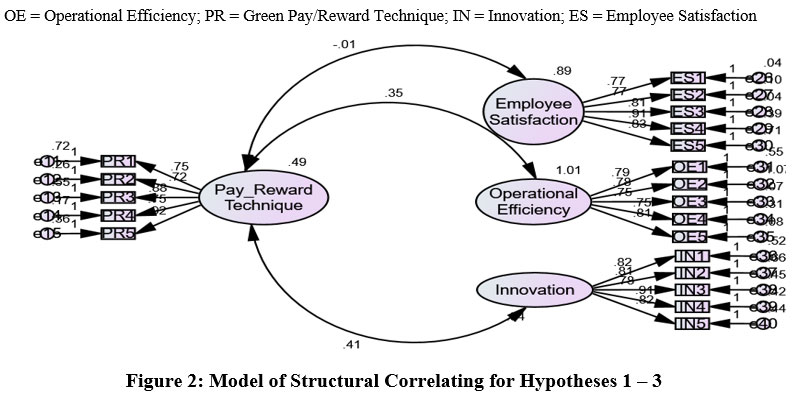 |
Figure 1: Model of Structural Correlating for Hypotheses 1 – 3 Click here to view Figure |
Table 1: Hypotheses Testing 1 – 3
|
Hypothesis |
|
Estimate (β) |
S.E. |
C.R. |
P |
|
|
Pay/Reward Techniques |
---> |
Employee satisfaction |
-.007 |
.026 |
-0.260 |
.795 |
|
Pay/Reward Techniques |
---> |
Operational efficiency |
.347 |
.040 |
8.730 |
.000 |
|
Pay/Reward Techniques |
---> |
Innovation |
.413 |
. 040 |
10.221 |
.000 |
Source: SPSS-AMOS V 23.0 Output, 2023
Testing of Hypothesis One
No association between deposit money banks’ green pay/reward techniques and employee satisfaction in Nigeria South-West.
It was estimated that the green pay reward technique and employee satisfaction covariance is -.007 with a standard error below zero is about .026 that attract absolute value of 0.795. More so, the green pay reward technique as well as employee satisfaction covariance is 0.05 level considering two-tailed. A negative and insignificant link among green pay/reward and employee satisfaction can be observed. As such, it can therefore, be upheld that no substantial link among deposit money banks green pay/reward and satisfaction of employee satisfaction in Nigeria South-West.
Testing of Hypothesis Two
No connection between deposit money banks’ green pay/reward techniques and operational efficiency in Nigeria South-West.
The estimated covariance of green pay/reward techniques with operational efficiency is 0.347 with .040 standard error but 8.730 covariance estimates that is pointing towards 0.05significant level path. With absolute value of 8.730 of probability of critical ratio below 0.05. That is, the green pay/reward covariance with operational efficiency is considerably poles apart at zero of 0.05 level of two-tailed. This shows that the green pay/reward techniques covariance with operational efficiency in the extrapolation indicates substantial bond of 0.000 at 0.05 level of significance. It could therefore be noticed that there is a encouraging and important link between green pay/reward and operational efficiency. We, therefore, admit our alternate hypothesis that stated that connection exist between green pay/reward techniques and deposit money banks’ operational efficiency in Nigeria South West.
Testing of Hypothesis Three
No connexion between deposit money banks’ green pay/reward techniques and innovation in Nigeria South-West.
The estimation of covariance of .413 was observed between green pay/reward techniques and innovation with a standard error of close to .040. The estimate of covariance of above zero standard error was 10.211 at 0.05 level of significance. Having critical ratio probability as large as 10.211 is below 0.05 in outright value. That is, a green pay/reward technique with innovation covariance is poles apart. This implies that, green pay/reward techniques covariance in the forecasting of innovation illustrates link of 0.000 at significance level of 0.05. It was, therefore, notices that there will be affirmative and important link between green pay/reward and innovation. We, therefore, discard the null and assent alternate hypothesis that connexion between deposit money banks’ green pay/reward techniques and innovation in Nigeria South-West exist.
Findings
Green Pay/Reward Techniques and Employee satisfaction of Deposit Money Banks (DMBs)
The study established that green pay/reward have link with employee satisfaction exposed, with p-value equals 0.795 that is above the level of significance of 0.05 and -0.052 was the path Coefficient (β). This reveals that green pay/reward technique have negative link with deposit money banks’ employee satisfaction in Nigeria South-West. Therefore, green pay/reward is not critical feature in firms in increasing employee satisfaction. This verdict challenges the submission that green pay possesses long term effect on both the employees and employer in terms of morale (employee satisfaction) according to (Krithika, DivyaPriyadharshini & GokulaPriya, 2019) .
Green Pay/Reward Techniques and Operational efficiency of DMBs
The outcome of hypothesis on link between green pay/reward and operational efficiency revealed good relatedness. Relying on the decision rule stated the null hypothesis was rejected and we accept the alternate hypothesis. That is, if the green pay/reward is increase, it will induce the employees to perform better in their various organisational tasks with the Path Coefficient (β) of 0.347. This implies that Pay/Reward enjoy weak affirmative link to operational efficiency amongst the workforce indicating an increase in green pay/reward resulting in positive increase in operational efficiency. Furthermore, the coefficient of determination between green pay/reward and operational efficiency was 0.120 that is there is a 12% variation between green pay/reward and operational efficiency amongst the employees in DMBs. This means that green pay/reward increase by 12% will have multiplying effect operational efficiency in the organisation. This position is in tandem with that of Ahmad (2015) and Alharbi (2020) that submitted that green pay and rewards are essential way of rewarding employees for their performance and that green pay and rewards are link agent of employee’s interest and the organisation’s interest.
Green Pay/Reward Techniques and Innovation of Deposit Money Banks
The third analysis revealed that when employees are well remunerated in our organisations, they are most likely to search for new knowledge to invest new “things” because it has been revealed that green pay/rewards is significant with innovation by pointing to high correlation level between green pay/reward and innovation. This positive link indicates higher green pay/reward in the DMBs yield extra in terms of innovation amongst the workforce and at the same time reduction green pay/reward will at the same time attract reduction in innovation in the DMBs. The determination calculated coefficient (r2) equals 0.171 indicating an item modification in green pay/reward resulting in 17.1% variation in innovation. As such, the ability to pay or rewards their workers adequately will motivate the banks’ workforce to come up with new knowledge and idea on how to carry out their jobs and tasks better than before. The position of this study agrees with the submission of Sule and Onuoha (2020) that noted that pay must be in tandem with skill and knowledge possessed by the employee and his/her performance.
Conclusions
From the analysis of this study, two of the null hypotheses were debunked and one null hypothesis aligned with. That is, green pay/reward techniques can assist in boosting the operational efficiency and innovation and that it cannot boost satisfaction of employees in Nigeria South West deposit money banks. Simply put, we have link amongst green pay/reward technique and corporate non-financial performance measures – innovation and operational; we did not experience link amongst deposit money banks green pay/reward and employee satisfaction of Nigeria South-West.
Recommendations
Based on our findings and conclusion, it is hereby recommended that if deposit money banks and by extension, service providing firms intends to boost their operational efficiency and innovation, green pay/reward system should be intensified and looked into. Also, to improve employee satisfaction, green pay/reward technique should not be part of the variables to consider by deposit money banks.
Acknowledgement
There is no body or individual to acknowledged as the study was a self-sponsored research work.
Conflict of Interest
There is no conflict of interest.
Funding Sources
There is no funding sources.
References
- Aburahma, I, A. M., Abu Amuna, Y. M. & Aqei, A. M. (2020). The relationship between GHRM practices and organizational performance “case study: Gaza university”, International Journal of Academic Management Science Research, 4(4), 1-8.
- Ahmad, K. & Zabri, S. M. (2016a). The application of nonfinancial performance measurement in Malaysian manufacturing firms, Procedia Economics and Finance, 35, 476-484.
CrossRef - Ahmad, S. (2015). Green human resource management: Policies and practices, Cogent Business & Management, 2, 1-13.
CrossRef - Alharbi, M. F. (2020). Empirical evidence of impact of green human resource management practices and organization’s sustainability, African Journal of Hospitality, Tourism and Leisure, 9(2), 1-9.
- Amah, E. (2014). Corporate culture and organizational effectiveness, Ibadan University Press.
- Amah, E. (2016). Human resource management, Tema & T. Press.
- Carmeli, A. & Freund, A. (2004). Work commitment, job satisfaction, and job performance: An empirical investigation, International Journal of Organization Theory and Behavior, 6(4), 289-309.
CrossRef - Chen, T. Y. (2001). An estimation of x-inefficiency in Taiwan’s banks, Applied Financial Economics, 11(3), 237-242.
CrossRef - Chowdhury, S. H., Roy, S. K., Arafin, M. & Siddiquee, S. (2019). Green HR practices and its impact on employee work satisfaction – A case study of IBBL, Bangladesh, International Journal of Research and Innovation in Social Science, III(III), 129-138.
- Danaei, A. & Hosseini, A. (2013). Performance measurement using balanced scorecard: A case study of pipe industry, Management Science Letters, 3(5), 1433-1438.
CrossRef - Eferakeya, E. I. & Erhijakpor, E. O. (2020). Determinants of operating efficiency of Nigeria’s banking sector. PalArch’s Journal of Archaeology of Egypt/Egyptology, 17(7), 13151-13166.
- Gupta, V. & Chopra, M. (2016). Conceptualization of the balanced scorecard for organizational performance measurement, https://www.researchgate.net/publication/330998205_ Conceptualization_of_the_Balanced_Scorecard_for_Organizational_Performance_Measurement.
- Kaplan, R. S. & Norton, D. P. (1996). The balanced scorecard: Translating strategy into action, Harvard Business School Press.
- Kaplan, R. S. & Norton, D. P. (2001). Transforming the balanced scorecard from performance measurement to strategic management: Part 1, Accounting Horizon, 15(1), 87-104.
CrossRef - Karakas, A., Oz, Y. & Yildiz, M. R. (2017). The effect of innovation activities on organizational performance: A research on hotel businesses, Journal of Recreation and Tourism Research, 4(1), 49-59.
- Kotane, I. & Kuzmina-Merlino, I. (2012). Non-financial indicators for evaluation of business activity, European Integration Studies, 5, 213-219.
CrossRef - Krithika, J., DivyaPriyadharshini, N. & GokulaPriya, J. (2019). Green HRM –Practices in organisations, IOSR Journal of Business and Management, 21(3S1), 74-77.
- Likhitkar, P. & Verma, P. (2017). Impact of green HRM practices on organization sustainability and employee retention, International Journal for Innovative Research in Multidisciplinary Field, 3(5), 152-157.
- Olanipekun, W. D., Abioro, M. A., Akanni, L. F., Arulogun, O. O. & Rabiu, R. O. (2015). Impact of strategic management on competitive advantage and organisational performance- Evidence from Nigerian Bottling Company, Journal of Policy and Development Studies, 9(2), 185-198.
CrossRef - Olarewaju, O. M. (2016). Capital base and operational efficiency in Nigeria deposit money banks (evidence from a two-way fixed effect approach), Global Journal of Management and Business Research: D Accounting and Auditing, 16(1), 1-12.
- Onuoha, B. C, (2015). Business policy and strategy, African Entrepreneurship and Leadership Initiative.
- Onuoha, B. C. (2016). Corporate planning & strategy- A competitive perspectives for emerging economies, African Entrepreneurship and Leadership Initiative.
- Pham, N. T., Tuckova, Z. & Phan, Q. P. T. (2019). Greening human resource management and employee commitment towards the environment: An interaction model, Journal of Business Economics and Management, 20(3), 446-465.
CrossRef - Renwick, D. W. S., Redman, T. & Maguire, S. (2012). Green human resource management: A review and research agenda, International Journal of Management Review, https://DOI:10.1111/j.1468-2370.2011.00328.x
CrossRef - Sule, O. E. & Omoankhanlen, J. A. (2018). Union commitment and academic staff performance of public higher institutions in Nigeria, Scholarly Journal of Business Administration, 7(1), 1-14.
- Sule, O. E. & Onuoha, B. C. (2020). Green human resource management practices & organisational sustainability of private higher institutions in Abeokuta, Ogun State, International Journal of Business & Management Studies, 01(01), 18-30.
- Sule, O. E., Amuni, S. I., Obasan, K. A. & Banjo, H. A. (2015). Wages and salaries as a motivational tool for enhancing organizational performance: A survey of selected Nigerian workplace, EuroEconomica, 1(34), 7-26.
- Tang, G., Chen, Y., Jiang, Y., Paille, P. & Jia, J. (2018). Green human resource management practices: Scale development and validity, Asia Pacific Journal of Human Resources 56, 31-55.
CrossRef - Yuliansyah, Y. & Razimi, M. S. A. (2015). Non-financial performance measures and managerial performance: The mediation role of innovation in an Indonesian Stock Exchange-listed organization, Problems and Perspectives in Management, 13(4), 135-144.

This work is licensed under a Creative Commons Attribution 4.0 International License.