
Exploring the Modification Effect of Corporate Governance on the Relationship Between Good Governance and Logistics Performance
Lloyd George Banda1,2*  , Emmanuel George Yusufu3 and Greenson Chimjinthi Nyirenda4
1Department of Political Science, Stellenbosch University, Western Cape, South Africa .
2Department of Economic Planning and Development, Ministry of Finance and Economic Affairs, Lilongwe, Malawi .
3School of Law, Economics and Governance, University of Malawi, Malawi .
4Department of Economics, Catholic University of Malawi, Montfort Campus, Nguludi, Malawi .
http://dx.doi.org/10.12944/JBSFM.06.01.06
Efficient logistics management fills the puzzle that ensures the survival and maintenance of an economic system and the growth of its international trade relations. Aligned to sustainable development goal 16, the present study is an essential inquiry of knowledge that empirically examines (1) the role of public governance on logistics industry performance in Sub-Saharan Africa and (2) whether this relationship improves with the moderation effect of good corporate governance. We constructed a panel sample of annual aggregated data for sub-Saharan African countries from 2007 to 2020. The dataset was analyzed in STATA 18 using a dynamic robust endogeneity one-step system generalized method of moments (SyGMM) that yielded both short- and long-run coefficients. Empirical findings revealed that public governance negatively affects the performance of the logistics industry in both the short and long run. However, the effect became desirably positive when moderated with corporate governance as it showed that a per cent improvement in the corporate-public governance nexus results in a 1.01% and 2.09% improvement in logistics industry performance in the short and long run, respectively. Thus, the paper offers policy implications concerning corporate governance such as raising ethical standards and enhancing honesty and transparency regarding resource allocation.
Copy the following to cite this article:
Banda L. G, Yusufu E. G, Nyirenda G. C. "Exploring the Modification Effect of Corporate Governance on the Relationship Between Good Governance and Logistics Performance". Journal of Business Strategy Finance and Management, 6(1).
DOI:http://dx.doi.org/10.12944/JBSFM.06.01.06Copy the following to cite this URL:
Banda L. G, Yusufu E. G, Nyirenda G. C. "Exploring the Modification Effect of Corporate Governance on the Relationship Between Good Governance and Logistics Performance". Journal of Business Strategy Finance and Management, 6(1). Available here:https://bit.ly/47O1vJb
Download article (pdf) Citation Manager Publish History



Introduction
The logistics industry is an important puzzle in fulfilling the role of coordinating the primary, secondary, and tertiary industries. An economic system's smooth functioning depends on an organized logistics industry, without which the coordination of production, exchange, and consumption activities will be far-fetched. The success of the logistics industry is considered a key engine of economic expansion
Studies have shown that an improvement in the logistics industry of a country leads to an increase in economic prosperity
According to the rising corpus of information about Africa, the continent is advantageously evolving as a crucial trading bloc, especially for Asia and some regions of Europe
 | Figure 1: Main Threats to Sub-Saharan Africa’s Logistics Industry |
Source: Statista (2023)
The remainder of the research paper is structured as follows: Section 2 interrogates existing literature on the importance of the corporate-public governance nexus in the logistics sector. Section 3 describes the materials and methods used to analyze the data. Section 4 presents the empirical findings and discussion. Lastly, section 5 concludes and offers policy implications.
Literature Review
Recently, there has been an increase in global logistics reports. For example, the World Bank first published the Logistics Performance Index (LPI) in 2007
A similar study was conducted by
Various determinants of logistics performance in three categories – infrastructure, human capital, and institutions, were examined for Africa, Europe, and Asia
Evidence shows that research related to logistics performance is overwhelming across the globe. However, the role of corporate and public governance on logistic performance remains a theoretical expectation and not empirically proven. We have also noted that most studies examining corporate governance's role on logistics industry performance are microeconomic and country-specific and limited to a few firms. Thus, the current research is macro-econometric and examines the role of the corporate-public governance nexus on logistics performance in Sub-Saharan Africa. The premise dwells on the argument that the quality of governance institutions shapes the development outcomes of a country
Materials and Methods
Data
Data from 32 Sub-Saharan African countries from 2007 to 2020 was used to execute our empirical approach. The list of countries is given in Table A1 (Appendix A). The selection of countries and year ranges were guided by the data availability for the dependent variable (Logistics Performance) and the two primary independent variables of interest (public and corporate governance) at the time of the study.
Variables, Sources and Expectations
Logistic industry performance is the dependent variable, while public and corporate governance are the two main explanatory variables of interest. Data for the dependent variable is measured by the Logistics Performance Index (LPI), whose data values range from 1 to 5, with 1 and 5 representing poor and optimum logistics performance extremes, respectively. Data for the variable was obtained from the World Bank data bank (World Bank, 2022). Unlike
We also adopted corporate governance proxied by the ethical behaviour of firms (World Bank, 2022) as another primary independent variable of interest. Due to massive privatization and decentralization in most countries following the 1980s structural adjustment programs, structures of logistics performance are mostly contracted out to private firms. Therefore, there is a need for transparent interaction among public officials, politicians, and other stakeholders from the private sector. However, corporate governance in most African countries is poorly developed and highly marred with malpractices such as bidding and procurement fraud and offering non-durable goods and services to the government (Kheil et al., 2022). The corporate governance score is scaled from "1" for the worst performance to "7" for the outstanding performance of corporations. Table 1 details the study variables.
Table 1: Variable description
Variable | Code | Parameter | Source | Sign |
Logistics Performance | LPI | Logistics Performance Index | World Bank (2022) | --- |
Public/Good Governance | PGOV | Ibrahim Index of African Governance | Mo Ibrahim Foundation (2022) | + |
Corporate Governance | CGOV | Ethical Behavior of firms | World Bank (2020a) | + |
Urbanization | URBN | Percentage of urban population | World Bank (2023) | + |
Human Capital | HDI | Human development index | UNDP (2022) | + |
Political Instability | POS | Index of political instability | Kaufmann & Kraay (2023) | + |
Source: Authors’ analysis
Model Specification
The unexhaustive literature reviewed reveals endless determinants of logistics industry performance. However, this study focuses on the role of the corporate-public governance nexus on logistics industry performance. To control for omitted variables, we specify a model that incorporates various other determinants such as political instability, urbanization, and human capital development as control variables

Econometrically, equation 1 can be systematically linearly specified as follows;

Where: LPI represents logistics industry performance; GGOV denotes public/good governance; URBN is urbanization; HDI represents human capital; POS is Political instability. On the other hand, ?0 denotes the intercept; ?1, ?2, ?3, ?4, ?5 and ?6, are the coefficients to be estimated; ? depicts the country effect; ? represents the effect of time; ? is the random disturbance representation; i and t denote countries and time, respectively.
Our primary interest in this regression is the public governance, corporate governance variables, and the interaction term of the two variables (lnGOV = lnGGOVit * lnCGOVit. The nature of the logistics industry makes it classified as a quasi-public good or service, implying that the public sector possesses supreme power in investments such as sea and airports, roads, warehouses, trade and border regulations, import duties, and tariffs, among others. However, major private corporations will likely strongly influence the government to provide those amenities. Literature shows that public governance reduces the grabbing hand
Estimation Techniques: Blundell/Bond System GMM Estimator
Distinctively, the current research uses a dynamic panel technique which helps to check for robustness and assurance of the consistency of the coefficient of the main parameters of interest. Considering the dynamics of adjustments was crucial because the performance of any economy’s variable at any point in time hugely depends on its immediate past performance. Besides, panel models contribute more informative data, more degrees of freedom, and, more importantly, allow for dynamics of adjustments to estimate intertemporal relations
As argued earlier, logistics performance is a function of, among other things, the immediate past performance, which means that logistics performance is dynamic. Consequently, a model of logistics performance should contain one independent variable in the name of logistics performance for the past period, as shown in the equation below;

Where i = 1,…,N for N number of countries (cross-sections) ad t = 1,…,T for T time coverage of the study;  is a scalar and xit' is a vector of 1 x k regressors. On the other hand, the error component is presumed to be one-way such that:
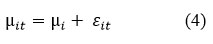
Where the error components are autonomous between one another, µi represents the unobservable individual-specific effect and ?it is the disturbance term.
It is important to note that there is a correlation relationship between the dynamic component Yi,t-1 with µi in equation (i) above. Such a correlation renders the use of ordinary least squares or static panel models (Random &and fixed effects produce biased and invalid or varying estimates. In the quest for unbiased and consistent estimates,

Nevertheless, if the autoregressive parameters are too large or the ratio of variance of the panel-level effect to variance of the idiosyncratic error is too large, then the AB estimator may yield poor results. To circumvent the problem,
Another novel part of this study is the ability to compute and interpret long-run estimates for the robust GMM. The notion that the GMM model only yields short-run results is highly ignored in many papers

Empirical Results
Descriptive Statistics
Tables 2 and 3 present summary statistics and the Pearson correlation analysis. Summary statistics show that LPI for Sub-Saharan Africa is critically very low, averaging only 2.52 out of 5 from 2007 to 2020. The slight standard deviation of 0.44 shows that data points for logistics performance are highly clustered around the mean, implicitly implying that many countries are performing poorly on this index in sub-Saharan Africa. The maximum logistics index of 4.915 was recorded in 2018 in Uganda, while the lowest index of 1.53 was recorded in 2007 in Botswana. For the two independent variables of interest, public governance for Sub-Saharan Africa averaged 50.97%, while corporate governance averaged 3.71 out of 7. The maximum performance in public governance of 79.5 was recorded in Mauritius in 2017, while the lowest score of 30.7 was recorded in Chad in 2012. On the other hand, Liberia recorded the overall maximum corporate governance performance of 6.60 in 2007, while the minimum score of 1.87 for corporate governance was recorded in Angola in 2018.
Table 2: Summary statistics
Variable | Mean | Std. Dev. | Min | Max | Obs. |
LPI (1 – 5) | 2.52 | 0.44 | 1.53 | 4.92 | 191 |
PGOV (%) | 50.97 | 10.14 | 30.70 | 79.5 | 384 |
CGOV (1 – 7) | 3.71 | 0.65 | 1.87 | 6.60 | 384 |
GOV | 5.09 | 0.86 | 2.29 | 7.19 | 384 |
HDI (0 – 1) | 0.51 | 0.09 | 0.34 | 0.80 | 418 |
POS (%) | 34.12 | 21.77 | 1.93 | 93.75 | 448 |
Note: LPI = logistics performance index, PGOV = public governance, CGOV = corporate governance, GOV= PGOV*CGOV, * = moderation, HDI = human development, URBN = urbanization, and POS = political instability, T = time span, n = sample size, N = observations.
Source: Authors’ computations from study data
Table 3: Pairwise correlation Matrix
lnLPI | lnPGOV | lnCGOV | Ln(GOV) | lnHDI | lnURBN | lnPOS | |
lnLPI | 1.00 | ||||||
lnPGOV | 0.3563*** | 1.00 | |||||
lnCGOV | 0.1536*** | 0.5784*** | 1.0000 | ||||
Ln(GOV) | 0.2282*** | 0.7617*** | 0.9680*** | 1.0000 | |||
lnHDI | 0.2551*** | 0.5867*** | 0.3531*** | 0.4725*** | 1.0000 | ||
lnURBN | -0.193*** | -0.210*** | 0.0502 | -0.0160 | -0.0710* | 1.0000 | |
lnPOS | 0.0189 | 0.5809*** | 0.3729*** | 0.4779*** | 0.4612*** | 0.0375 | 1.0000 |
Note: *** p<0.01, ** p<0.05, * p<0.1; ln = natural logarithm, LPI = logistics performance index, PGOV = public governance, CGOV = corporate governance, * = moderation, HDI = human development, URBN = urbanization, and POS = political instability
Source: Authors’ computation from study data
Table 3 shows the strength of linear relationships among our series lnLPI, lnPGOV, lnCGOV, lnGOV, lnHDI, lnURBN, and lnPOS. We employed the Pairwise correlation matrix, which yields a value between -1 to 1 for any pair of variables, with a coefficient value of -1 meaning a complete inverse linear correlation, 0 meaning the absence of any correlation, and + 1 being a complete direct or positive correlation. Our results indicate that all independent variables lnPGOV (0.38), lnCGOV (0.15), lnGOV (0.24), lnHDI (0.25), and lnPOS (0.03) depict a positive relationship with the dependent variable, except lnURBN (-0.14). Importantly, these dependent variables, except political instability, are significant at a 1% level. All coefficients along the table's diagonal are meaningless because they depict a variable’s self-perfect correlation.
Bond, Hoeffler and Temple (2001) GMM Selection Criteria
There are two main types of GMM methods, namely, difference GMM (DiGMM) and systems GMM (SyGMM), each of which has one- and two-step sub-categories. It is always critical for researchers to decide whether to run a difference or systems GMM. To do this, we ran a pooled OLS and Fixed effect and observed the coefficient of the lagged dependent variables in each model. Then we ran the difference GMM and observed the coefficient of the lagged dependent variable. The decision criteria are to run a systems GMM if the lagged dependent variable of a difference GMM model is lower or close to the lagged dependent variable of the fixed effect model
Table 4: GMM Decision criteria
Model | Variable | Coefficient |
Pooled OLS (upper bound) | l.lnLPI | 0.8332444 |
Fixed Effect (lower bound) | l.lnLPI | 0.7159549 |
Difference GMM | l.lnLPI | 0.5147365 |
Source: Authors’ computation from study data
Results in Table 4 indicate that the coefficient of the lagged dependent variable of the difference GMM is lower or closer to the lower bound, such that a systems GMM model for is deemed suitable since interpreting DiGMM results will lead to biased and inconsistent estimation in this case.
Diagnostic Tests
A specification of the GMM method requires variables to be in their natural form or logarithmically transformed. The issue of non-stationarity of variables generates no worries with the Blundel/Bond dynamic panel model because the regression technique generates self-differencing variables
Table 5: Hansen test of over-identifying restrictions
Model | ?2-statistic | Prob>?2 |
lnLPI | 12.18 | 0.431 |
Source: Authors’ computation from study data
Table 6: AB Test for autocorrelation
Order | z | Prob>z | |
lnLPI | AR(1) | 0.55 | 0.579 |
AR(2) | -1.88 | 0.60 |
Further, to ensure the validity of moment conditions in the GMM model, researchers need to deal with serial correlation in the idiosyncratic errors. In this study, we employed the
Results and Discussion
Model Estimation
Having passed all necessary diagnostic tests for a dynamic one-step systems GMM, we investigated the role of the public-corporate governance nexus on logistics industry performance in Sub-Saharan Africa. To begin with, the coefficient of the lagged dependent variable is desirably positive and statistically significant at a 5% level. That is, a percentage point improvement in the previous year’s performance of logistics industry performance will improve logistics performance by 0.51 percent in the immediate subsequent year. Studies that examine the impact of the lagged dependent variable or the inertia such as
Table 7: Robust endogeneity system GMM results
One-step System GMM (Dep. Var: lnLPI) | ||||
Short-run | ||||
Coef. | Std. errr. | t. | Prob>| t | | |
l.lnLPI | 0.518 | 0.190 | 2.72 | 0.011 |
lnGGOV | -1.008 | 0.515 | -1.96 | 0.059 |
lnCGOV | -3.924 | 1.704 | -2.30 | 0.028 |
lnGOV | 1.0113 | 0.442 | 2.29 | 0.029 |
lnPOS | -0.033 | 0.018 | -1.82 | 0.079 |
lnHDI | 0.034 | 0.058 | -0.58 | 0.565 |
Long-run | ||||
Coef. | Std. err | z. | Prob>| z | | |
lnGGOV | -2.090461 | 1.111594 | -1.88 | 0.060 |
lnCGOV | -8.137328 | 3.470774 | -2.34 | 0.019 |
lnGOV | 2.09698 | .8997638 | 2.33 | 0.020 |
lnPOS | -.0689102 | .0239782 | -2.87 | 0.004 |
?2 | 3491.85 | |||
P | 0.000 | |||
N | 343 | |||
Year Dummies | Yes | |||
Groups/Instruments | 32/29 | |||
Source: Authors’ computations from study data
The coefficients of corporate governance and public governance are negative and statistically significant in both time periods. For example, a percentage point improvement in corporate governance, public governance, and political instability deteriorates logistics performance by 3.92%, 1.01%, and 0.03%, accordingly. However, when moderated with corporate governance, public governance yields a positive and statistically significant effect on logistic performance with 1.01 and 2.09 elasticities in the short and long run, respectively. That is, a percent improvement in the corporate-public governance nexus improves logistics performance by 1.01% and 2.09% points, at ceteris paribus. The results concur with
Unsurprisingly, political instability is negative and statistically significant in both the short (at 10% level) and long run (at 5% level). In the long run, a one-unit increase in political instability or violence will deteriorate logistics performance by 0.068%, holding other factors constant. That is, an increase in the instability of the political environment will worsen the logistics performance of Sub-Saharan Africa. This result aligns with the research expectation and the findings of
Conclusions and Recommendations
The current study investigated the role of good public-corporate governance nexus on the performance of the logistics industry in sub-Saharan economies. The logistics industry coordinates supply chain partners among the three sectors of an economy – primary, secondary and tertiary industries. Therefore, the study is necessary because sound logistics management fills the puzzle that ensures the survival of an economic system and the maintenance of its international trade relations and competitiveness through the domino effect. For example, to function, the secondary and tertiary industries need supplies from the primary sector. This relationship is not a one-way chain because the primary sector also needs technical services from the secondary and tertiary sectors to improve efficiency. Thus, the logistics industry offers a desideratum coordination that improves the wellness of an economy and the people living in it.
The study data was obtained from the World Bank and the Mo Ibrahim Foundation. First, findings from the robust endogeneity GMM reveal that the lag of the dependent variable is statistically significant. The results indicate that a one-unit increase in the past year’s performance of the logistics industry will positively influence the present year performance by 0.518 percent, holding other factors constant. It entails, therefore, that logistics industry performance is persistence in a way that a past year performance will have a direct influence on the present year performance. Second, good governance depicts negative and statistically significant coefficients in both the short-and long run. For example, a one-unit improvement in good governance will worsen logistics industry performance by 1.008% and 2.09%, respectively. Similarly, corporate governance is found to be negative and statistically significant in both the short-and long run with the marginal effect of 3.93% and 8.14, accordingly. However, this relationship becomes positive with the moderation effects of corporate governance. For example, when moderated with corporate governance, good governance depicts a positive influence on the performance of logistics industry with a marginal effect of 1.01% and 2.09% in the short-and long-run, respectively.
The findings offer important information for private firms, logistics industry managers, and national policymakers. Firstly, African governments should be strongly alerted about the importance of implementing ethical standards by strengthening the ethics training of their labor force and enhancing honesty and transparency regarding resource allocation through national curricula or workplace training. The government should define and set structures and procedures for employees to voice their ethical concerns without indictments of persecution. Consequently, all engagements and interactions in the business arena will consider ethical issues. Secondly, African governments should strengthen governance structures such as the rule of law and justice, accountability and transparency, public administration, human rights, and other foundations for economic opportunity. All in all, Sub-Saharan African governments should not treat corporate and public governance as independent of each other due to their complementary positive influence on macroeconomic performance such as the logistics industry. Since political instability was found to negatively influence logistics industry, African governments should consider means to avoid political violence while maintaining healthy political competition.
While the study provides novel empirical, methodological insights, and robust results, little is known about how individual components of the Mo Ibrahim Index of African Governance (MIIAG) influence logistics industry performance. Similarly, our composite index of corporate governance shields the relevance of its components on logistics performance. Thus, we recommend that future researchers investigate the issues and dive deeper to understand which components of governance are critical for specific elements of logistics performance. In addition, the Generalized method of moments only gives short-run results. A separate simulation for long-run results is performed only on those variables that are significant in the short-run. This is a weakness because cointegration methods such as Panel ARDL models may have a variable insignificant in the short-run but desirable significant in the long-run. Future researchers should, therefore, consider employing cointegration and error correction methods.
Acknowledgement
The authors thank the anonymous reviewers for their insightful comments that improved the quality of the manuscript
Funding Sources
The author(s) received no financial support for the research, authorship, and/or publication of this article.
Conflict of interest
The authors do not have any conflict of interest.
Data Availability Statement
The Mo Ibrahim Index of African Governance can be accessed at: https://mo.ibrahim.foundation/iiag, and the World Development Indicators can be accessed at: https://databank.worldbank.org/source/worlddevelopment-Indicators.
Ethics Statement
This research did not involve human participants, animal subjects, or any material that requires ethical approval.
Authors' Contribution
All authors designed the model and the computational framework and analyzed the data. Banda wrote the manuscript with input from all authors.
- Abdulla, H. (2023). China Rolls Out Five Year Plan to Upgrade Logistics Sector. Just Style.
- Acemoglu, Daron, and J. A. R. (2012). Why Nations Fail: The Origins of Power, Prosperity and Poverty (1st ed.). Crown: New York.
- Adeleye, N., Osabuohien, E., & Bowale, E. (2017). The Role of Institutions in the Finance-Inequality Nexus in Sub-Saharan Africa. Journal of Contextual Economics, 137(1–2), 173–192. https://doi.org/10.3790/jce.137.1-2.173
- Akdamah, E. (2022). The Effect of Human Development on the logistics efficiency of countries. Mehmet Akif Ersoy Üniversitesi ?ktisadi ve ?dari Bilimler Fakültesi Dergisi, 9(2), 871–896. https://doi.org/10.30798/makuiibf.912836
- Ali, A., Cao, M., Allen, J., Liu, Q., Ling, Y., & Cheng, L. (2023). Investigation of the drivers of logistics outsourcing in the United Kingdom’s pharmaceutical manufacturing industry. Multimodal Transportation, 2(1), 100064. https://doi.org/10.1016/j.multra.2022.100064
- Arellano, M., & Bond, S. (1991). Some Tests of Specification for Panel Data: Monte Carlo Evidence and an Application to Employment Equations. The Review of Economic Studies, 58(2), 277. https://doi.org/10.2307/2297968
- Arellano, M., & Bover, O. (1995). Another look at the instrumental variable estimation of error-components models. Journal of Econometrics, 68(1), 29–51. https://doi.org/10.1016/0304-4076(94)01642-D
- Azam, M., & Adeleye, B. N. (2023a). Impact of carbon emissions sources on life expectancy in Asia and the Pacific region. Natural Resources Forum. https://doi.org/10.1111/1477-8947.12303
- Azam, M., & Adeleye, B. N. (2023b). Impact of carbon emissions sources on life expectancy in Asia and the Pacific region. Natural Resources Forum. https://doi.org/10.1111/1477-8947.12303
- Banda, L. G. (2023c). Good Governance and Human Welfare Development in Malawi: An ARDL Approach. Malawi Journal of Social Sciences, 22, 89–119. https://doi.org/10.2139/ssrn.4235681
- Banda, L. G. (2023a). State Capacity and Growth in Sub-Saharan Africa: A Dynamic Panel Examination of Smith’s Pillars of Prosperity . State Responsibility: Fourth Industrial Revolution, Sustainability and Good Governance , 1–33.
- Banda, L. G. (2023b). The Institutions of Rule of Law and Inclusive Economic Development: Empirical Evidence from Southern African Development Community. SSRN Electroic Journal. https://ssrn.com/abstract=4386273
- Ben-Amar, W., & McIlkenny, P. (2015). Board Effectiveness and the Voluntary Disclosure of Climate Change Information. Business Strategy and the Environment, 24(8), 704–719. https://doi.org/10.1002/bse.1840
- Blundell, R., & Bond, S. (1998). Initial conditions and moment restrictions in dynamic panel data models. Journal of Econometrics, 87(1), 115–143. https://doi.org/10.1016/S0304-4076(98)00009-8
- Bond, S., Hoeffler, A., & Temple, J. (2001). GMM Estimation of Empirical Growth Models (21; Economics Group, Nuffield College).
- Chakraborty, S., Sharma, A., & Vaidya, O. S. (2020). Achieving sustainable operational excellence through IT implementation in Indian logistics sector: An analysis of barriers. Resources, Conservation and Recycling, 152, 104506. https://doi.org/10.1016/j.resconrec.2019.104506
- Cheru Fantu, C. O. (2010). The rise of China and India in Africa: Challenges, opportunities and critical interventions. Z Books.
- Dassah, O., & Tshishonga, N. (2011). Good governance analyzing performance of Economic Community of West African States and Southern African Development Community members on Mo Ibrahim Index of African Governance. African Journal of Goverance and Development, 1(1), 1–27.
- Douglass C. North, John Joseph Wallis, & Barry R. Weingast. (2009). Violence and the Rise of Open-Access Orders. Journal of Democracy, 20(1), 55–68. https://doi.org/10.1353/jod.0.0060
- Ejemeyovwi, J. O., & Osabuohien, E. S. (2020). Investigating the relevance of mobile technology adoption on inclusive growth in West Africa. Contemporary Social Science, 15(1), 48–61. https://doi.org/10.1080/21582041.2018.1503320
- Ellis, S. (1993). Rumour and power in Togo. Africa, 63(4), 462–476. https://doi.org/10.2307/1161002
- Erkan, B. (2014). The Importance and Determinants of Logistics Performance of Selected Countries. Journal of Emerging Issues in Economics, Finance and Banking (JEIEFB), 3(6), 1237–1254.
- Hsiao, C. (2003). Analysis of panel data. Cambridge University Press.
- Islam, Y., & Siddiqui, D. A. (2019a). The Effect of External Factors towards the Logistics Performance in Efficiency of Material Supply for the Pipeline Construction Based Projects: Evidence from the Oil and Gas Industry in Pakistan. SSRN Electronic Journal. https://doi.org/10.2139/ssrn.3510617
- Islam, Y., & Siddiqui, D. A. (2019b). The Effect of External Factors towards the Logistics Performance in Efficiency of Material Supply for the Pipeline Construction Based Projects: Evidence from the Oil and Gas Industry in Pakistan. SSRN Electronic Journal. https://doi.org/10.2139/ssrn.3510617
- Jen, C. T., Hu, J., Zheng, J., & Xiao, L. L. (2020). The impacts of corporate governance mechanisms on knowledge sharing and supply chain performance. International Journal of Logistics Research and Applications, 23(4), 337–353. https://doi.org/10.1080/13675567.2019.1691515
- Jhawar, A., Garg, S. K., & Khera, S. N. (2014). Analysis of the skilled work force effect on the logistics performance index—case study from India. Logistics Research, 7(1), 117. https://doi.org/10.1007/s12159-014-0117-9
- Khadim, Z., Batool, I., Akbar, A., Poulova, P., & Akbar, M. (2021). Mapping the Moderating Role of Logistics Performance of Logistics Infrastructure on Economic Growth in Developing Countries. Economies, 9(4), 177. https://doi.org/10.3390/economies9040177
- Kroesbergen, H. (2020). African leadership and the kind of reality of the spirit world. HTS Teologiese Studies / Theological Studies, 76(2). https://doi.org/10.4102/hts.v76i2.5846
- Kuteyi, D., & Winkler, H. (2022). Logistics Challenges in Sub-Saharan Africa and Opportunities for Digitalization. Sustainability, 14(4), 2399. https://doi.org/10.3390/su14042399
- Lee, H., Cashin, A. G., Lamb, S. E., Hopewell, S., Vansteelandt, S., VanderWeele, T. J., MacKinnon, D. P., Mansell, G., Collins, G. S., Golub, R. M., McAuley, J. H., Localio, A. R., van Amelsvoort, L., Guallar, E., Rijnhart, J., Goldsmith, K., Fairchild, A. J., Lewis, C. C., Kamper, S. J., … Henschke, N. (2021). A Guideline for Reporting Mediation Analyses of Randomized Trials and Observational Studies. JAMA, 326(11), 1045. https://doi.org/10.1001/jama.2021.14075
- Liu, J., Tang, J., Zhou, B., & Liang, Z. (2018). The Effect of Governance Quality on Economic Growth: Based on China’s Provincial Panel Data. Economies, 6(4), 56. https://doi.org/10.3390/economies6040056
- Lund, J. (2016). The surprising importance of governance in the logistic performance of nations. LinkedIn. https://www.linkedin.com/pulse/surprising-importance-governance-logistic-performance-john-lund/
- Magazzino, C., Alola, A. A., & Schneider, N. (2021). The trilemma of innovation, logistics performance, and environmental quality in 25 topmost logistics countries: A quantile regression evidence. Journal of Cleaner Production, 322, 129050. https://doi.org/10.1016/j.jclepro.2021.129050
- Manja, L., Silumbu, E., & Chaweza, L. (2022). Determinants of demand for international reserves in the SADC region. African Review of Economics and Finance, (ISSN 2042.
- Mkandawire, T. (2007). ‘Good governance’: the itinerary of an idea. Development in Practice, 17(4–5), 679–681. https://doi.org/10.1080/09614520701469997
- Mo Ibrahim Foundation. (2020). 2020 Ibrahim Index of African Governance. Mo Ibrahim Foundation. https://mo.ibrahim.foundation/iiag
- Munim, Z. H., & Schramm, H.-J. (2018). The impacts of port infrastructure and logistics performance on economic growth: the mediating role of seaborne trade. Journal of Shipping and Trade, 3(1), 1. https://doi.org/10.1186/s41072-018-0027-0
- Naa Amua Dodoo, R., Appiah, M., & Tetteh Donkoh, D. (2020). Examining the factors that influence firm performance in Ghana: a GMM and OLS approach. National Accounting Review, 2(3), 309–323. https://doi.org/10.3934/NAR.2020018
- Nica, E., Poliak, M., Alpopi, C., Kliestik, T., Manole, C., & Burlacu, S. (2023). Impact of Trade, FDI, and Urbanization on Female Employment System in SAARC: GMM and Quantile Regression Approach. Systems, 11(3), 137. https://doi.org/10.3390/systems11030137
- Pan, W.-T., Jiang, B., Wang, Y., Cai, Y., & Ji, X. (2022). Comparison and Suggestions of Logistics Performance Index of Main Countries of Belt and Road Strategy Based on Bootstrap DEA Model. Computational Intelligence and Neuroscience, 2022, 2159578. https://doi.org/10.1155/2022/2159578
- Pasko, O., Chen, F., & Yao, X. (2020). The relationship between corporate governance and financial performance in ?hinese logistics-related listed companies. Management and Entrepreneurship: Trends of Development, 4(14), 8–22. https://doi.org/10.26661/2522-1566/2020-4/14-01
- Roodman, D. (2007). A Note on the Theme of Too Many Instruments (125).
- Roodman, D. (2009a). A Note on the Theme of Too Many Instruments *. Oxford Bulletin of Economics and Statistics, 71(1), 135–158. https://doi.org/10.1111/j.1468-0084.2008.00542.x
- Roodman, D. (2009b). How to do Xtabond2: An Introduction to Difference and System GMM in Stata. The Stata Journal: Promoting Communications on Statistics and Stata, 9(1), 86–136. https://doi.org/10.1177/1536867X0900900106
- Samarasinghe, T. (2019). The relationship between institutions and economic development. MPRA Paper No. 97755.
- Sergi, B. S., D’Aleo, V., Konecka, S., Szopik-Depczy?ska, K., Dembi?ska, I., & Ioppolo, G. (2021). Competitiveness and the Logistics Performance Index: The ANOVA method application for Africa, Asia, and the EU regions. Sustainable Cities and Society, 69, 102845. https://doi.org/10.1016/j.scs.2021.102845
- Sezer, S., & Abasiz, T. (2017). The Impact of Logistics Industry on Economic Growth: An Application in OECD Countries. Eurasian Journal of Social Sciences, 5(1), 11–23. https://doi.org/10.15604/ejss.2017.05.01.002
- Shao, S., Yang, Z., & Si, W. (2023). An analysis of logistics financing prospects in Singapore. SHS Web of Conferences, 163, 03032. https://doi.org/10.1051/shsconf/202316303032
- Suki, N. M., Suki, N. M., Sharif, A., & Afshan, S. (2021). The role of logistics performance for sustainable development in top Asian countries: Evidence from advance panel estimations. Sustainable Development, 29(4), 595–606. https://doi.org/10.1002/sd.2160
- Tawiah, V. (2023). The Effect of IPSAS Adoption on Governance Quality: Evidence from Developing and Developed Countries. Public Organization Review, 23(1), 305–324. https://doi.org/10.1007/s11115-022-00625-w
- USAID|Deliver Project, T. O. 1. (2009). No Title. The Logistics Handbook: A Practical Guide for Supply Chain Managers in Family Planning and Health Programs.
- Uyar, A., Fernandes, V., & Kuzey, C. (2021). The mediating role of corporate governance between public governance and logistics performance: International evidence. Transport Policy, 109, 37–47. https://doi.org/10.1016/j.tranpol.2021.05.023
- Wong, W. P., & Tang, C. F. (2018). The major determinants of logistic performance in a global perspective: evidence from panel data analysis. International Journal of Logistics Research and Applications, 21(4), 431–443. https://doi.org/10.1080/13675567.2018.1438377
- World Bank. (2019). Aggregated LPI 2012-2018. https://lpi.worldbank.org/
- World Bank. (2020). Urban population (% of the total population). World Bank. https://data.worldbank.org/indicator/SP.URB.TOTL.IN.ZS?view=chart
- XiaofeI, L., & Fen, C. (2021). ImpactofLogisticsDevelopmentonEconomicGrowth:An EmpiricalResearchfromGuangdongProvinceinChina. Complexity, 2021, 12. https://doi.org/https://doi.org/10.1155/2021/9950935

This work is licensed under a Creative Commons Attribution 4.0 International License.