
Psychographic Determinants of Organic Tea Consumption: An Empirical Study
Shalini Kakkar* 
1Department of Marketing, Chetana’s Institute of Management and Research, Mumbai, Maharashtra India .
http://dx.doi.org/10.12944/JBSFM.07.01.03
Indian consumers value the consumption of tea as a habitual and social concept. However, with increased health problems in society, a new variant of organic tea has emerged providing all with natural flavors. Organic tea consumption has grown multifaceted with rapid urbanization encompassing consumer health benefits, cultural alignment, and environmental sustainability leading to growth in usage and awareness. The organic food market landscape is in the early stages of growth hence the study will help explore consumers' attitudes, beliefs, and preferences in consuming organic tea. The study will be done in areas of Mumbai suburbs to understand attitudinal perspectives influencing customers' intentions to purchase organic tea. The study provides empirical evidence by collecting data through structured questionnaires so that consumption patterns are noticed based on factors like health and wellness, environmental, and ethical concerns, lifestyle and social influences, brand preferences, and emotional and cultural connections. The application of appropriate statistical tests will examine the significance of the selected factors on purchase intentions of organic tea. The findings of the study will directly impact the novel entrants in the organic tea market so that strategies can be revised to give the product a mass appeal and create awareness of its utility in its consumption.
Copy the following to cite this article:
Kakkar S. "Psychographic Determinants of Organic Tea Consumption: An Empirical Study". Journal of Business Strategy Finance and Management, 7(1).
DOI:http://dx.doi.org/10.12944/JBSFM.07.01.03Copy the following to cite this URL:
Kakkar S. "Psychographic Determinants of Organic Tea Consumption: An Empirical Study". Journal of Business Strategy Finance and Management, 7(1). Availablie here: https://bit.ly/43gAAFA
Download article (pdf) Citation Manager Publish History



Introduction
Tea is the most consumed beverage after water (Ho et. al 2008), (Rothenberg and Zhang 2019). Indian consumers view tea consumption as a habitual and social concept. Tea has numerous health advantages in addition to being a stimulant (Storozhuk 2022). Camelia sinensis plant produces five varieties of tea- black, green, white, oolong, and dark teas. Worldwide demand for tea increased during the COVID-19 pandemic as tea was considered to have immune-boosting properties. (Fortune Business Insights 2023) Growth expansion of the Organic tea market stands to around CAGR of 8.4% from the year 2021 to 2026, almost 10% of the European market (Global Market Report 2024). The consumer preference push is a result of social media awareness for healthy beverages. India also witnessed the growth of retail organic tea consumption at a CAGR of 17.3% from 2016 to 2021. (Agriculture and Agri-Food Canada, 2022) The environment is prevalent now with diseases where health concerns have gained importance, therefore market has new tea variants with natural flavors such as green tea and organic tea. The last decades of organic tea consumption are dominated by North America, but significant growth is also visible in the Asia Pacific region.
Regular tea consumption can reduce depression risk but offer additional benefits such as anti-aging, pro-metabolic, and anti-diabetic. (Rothenberg and Zhang 2019), (DaSilva 2013), (Legeay et.al 2015). Organic tea is widely acknowledged as a healthy and safe beverage free of chemical fertilizers and pesticides (Sumi and Kabir 2018), (Bagchi et. al 2015). Organic tea maintains the well-being of ecosystems, soils, and human health as it is cultivated by unique production systems. (Hazra 2006). There are many reasons as increased awareness, and customer income enhancement and the government has imposed strict rules on promoting sustainable agriculture by receiving certifications from accredited organizations (Jensen et. al 2019). There are various studies on organic tea plantations, needs, and practices based on sustainable development, but limited knowledge is available on the customer's attitude toward the purchase decision of organic tea. A study (Sumi and Kabir, 2018) discovered that factors predicting consumers' desire to purchase organic tea are environmental concerns, health benefits, trust, and perceived cost. The study throws importance to retail experience in adopting innovative methods for in-store experience. There is a lack of understanding of the role of mediators in influencing the consumer's purchase decision. Business managers related to the organic tea industry have limited knowledge about market forces in the Indian scenario. The study will intend to reduce the gap by studying important variables that influence the consumer's perception of the healthfulness of organic tea.
(Organic Tea Market Analysis 2024-2028).The organic tea market will reach USD 667.5 Mn from 2023-2028 with a CAGR of 9.45%. Organic tea is gradually gaining popularity among consumers because of the presence of numerous health benefits for the consumption of this product. A healthier and natural beverage is derived from the preparation of organic tea since the cultivation of tea entails no use of artificial fertilizer, pesticides, or chemicals. From choices of tastes and blends to herbal and medicinal teas the next organic tea market movement is product innovation. Naturally, this trend is expected to continue, as the traditional focus of consumers on healthy and meaningful life experiences is shifting to the center. Consumers' desire for organic teas among merchants and other users who care for their health is also forcing product line expansions, thus seeking to ensure that there are more flavors of tea offered.
Clean-label product means the product with no artificial ingredients or additives; this specialty tea especially the one packed in tea bags is now a trend. Since people believe organic food items can enhance food hygiene, they are opting for them regularly. Organic crops are also endowed with 'antioxidant' effects often due to their phenol, polyphenol, and drink flavonoid computation. To maintain good immune health and combat infections, antioxidants cannot be overemphasized.
They also help promote helpful bacteria and maintain gut health since all the body systems are somehow connected to the gut. About foods and similar products, dangerous materials such as cadmium are mentioned, because their influence on the human organism may be rather questionable. Familiar products should therefore be scrutinized significantly in an endeavor not to compromise the overall well-being of the intestines. It has been noted that the market for these products is expanding, which means that safety and antioxidant requirements in these products must be strictly followed to protect consumers.
Some of the causes that are stimulating the market's growth include the health benefits of organic tea. Customers are replacing other beverages with them because it is made from medicinal plant extracts and Herbs that are healthy for the body. On the plus side, its nutrient composition helps address colds and boost immunity and digestion.
The rising popularity of organic matcha green tea is a unique factor that is driving the market into the targeted expansion. Concisely, organic matcha green tea is powdered green tea in the Japanese form of preparation. It is due to its numerous health benefits that customers' demand has been rising. One of this green tea's unique selling propositions is that it is neither too high in theanine nor caffeine but is just right in both. Moreover, the basic organoleptic benefit of consuming organically prepared match green tea is that it enhances clear vision and alert mind.
The benefits of organic Matcha tea for health because it provides valuable antioxidants such as catechins that help lessen inflammation. Further, because of its benefits to the skin especially to women, this tea is gradually gaining popularity among many women. For these reasons, it is expected that such factors will drive the market in the course of the forecast years.
The market of tea in India is escalating because of the increased awareness of the health benefits of herbal and organic teas and their availability through online shops. According to the 2022 India Today, survey 45 percent of Indian customers opted for organic products because of health reasons. A report by the Food Safety and Standards Authority of India reckons organic tea consumption will grow by an average of 12% per year in the next five years. Out of the approved ninety percent tea garden of Darjeeling, the Tea Board, about 62 gardens cultivate organic tea.
Today, using Internet resources, such as Amazon, Flipkart, and others, people can buy different types of Artisan and Organic tea from across the world. Organic food segments have been added by online grocery-selling companies such as Grofers and Big Basket to satisfy health-conscious tea drinkers. Another strong factor that contributed to the increase in the tea market in India is the ability of the organizations to provide subscription services to clients to be able to offer teas monthly.
The importance of study will focus on lifestyle factors influencing the consumer behaviour purchase decisions and understanding psychographic influences on personal values, beliefs and lifestyle choices. Consumer understanding can be provided so that strategies can be developed for health conscious and environmentally care consumers.
Materials and Methods
A consumer has a well-controlled personal perspective in purchase intentions but in the case of organic tea certain external factors like brand, time, and place play major roles in their decision-making. (Chen Y ,2011). According to (Ajzen 2006) consumer behavior is driven by subjective norms, perceived behavioral control, and attitude. Intentions to buy organic tea do not have limitations of higher price and indifferent taste but are influenced by demographic factors, social norms, environment, and health attitudes. (Dang, et.al 2022) in their study found that the purchase intention of organic drinking products is influenced strongly by food health perception and environmental consciousness whereas CSR beliefs provide a moderating link between customer motivation and behavioral intentions. (Gandhi 2021) in his study found that significant parameters like social factors, environmental awareness, government initiatives, general awareness, family traditions, advertisement, health care, and youth appeal influence green consumer behavior. (Doanh et.al 2022) in their findings indicate how farmers' intentions are being converted to organic production as it has an impact on perceived economic benefit and market accessibility. (Attri, R. and Bairagi R. 2023) in their case explained the importance of sustainable living and emphasized consuming organic food products. (Drejerska, et.al 2021) in their study found that the health benefits of organic food are a strong reason for purchase intentions and hence consumer demand undergoes evolutionary changes.
(ORG MARG, 2002) Organic tea is the most popular marketed product in India. Organic food products are high-end consumers as prices are perceived as higher due to low volumes and high logistic costs. (Chakrabarti and Baisya 2007). Consumers' perception is that organic foods are safe to consume as they are free from any chemical additives and preservatives. (Padel and Foster 2005).
A descriptive research design was adopted to gain insights into customer attitudes, beliefs, and preferences for organic tea. Primary data was collected from 139 respondents using a survey method in the suburbs of Mumbai. A non-probability judgemental sampling method was adopted for consumers who have potential interests in organic tea. The sampling method has certain limitations as it introduces researcher’s bias which may lead to inappropriate representation of population. Findings cannot be generalized as sample is random. Sample selection have dependence on Researcher’s expertise which can have variable outputs.
The sample size of 139 respondents was targeted to get enough data for statistical analysis. A structured questionnaire was developed to collect data on consumer attitudes, beliefs, and consumption patterns. The questionnaire was divided into sections like Demographics, Attitudes, and beliefs related to health and wellness, environmental sustainability, social impact, and Lifestyle factors and Brand preferences. Data is statistically analyzed in SPSS using descriptive statistics, Mann Whitney tests, Krushal Wallis test, and Chi-Square test.
The Objectives of the study are as follows
Exploring customer preferences, beliefs, and attitudes toward organic tea.
To study purchase intentions of organic tea through elements of brand preferences, lifestyle influences, ethical concerns, social influences environmental considerations, health and wellness, and cultural ties.
Results
Table 1: Demographic Profile of the Respondent
Sample Demographics | Percentage | |
Age (Years) | 18 to 24 | 7.7 |
25 to 34 | 13.1 | |
35 to 44 | 26.9 | |
45 to 54 | 36.9 | |
55 to 64 | 11.5 | |
more than 65 | 3.8 | |
Gender | Male | 40 |
Female | 60 | |
Occupation | Student | 10 |
Professional | 52.3 | |
Homemaker | 14.6 | |
Retired | 4.6 | |
Self Employed | 17.7 | |
Annual Income | Less than 5 lakhs | 9.2 |
5 Lakhs to 10 Lakhs | 18.5 | |
10 Lakhs to 20 lakhs | 30 | |
More than 20 lakhs | 42.3 | |
The demographic profile of the respondents provides an understanding of the diverse distribution of respondents (Table 1) across age, gender, occupation, and income. Most of the respondents 36.9% are in the age group of 45 to 54 years. There is a good representation of the females with 60%. Occupationally 52.3% are professionals with the thin representation of retired individuals to 4.6%. They belonged to various annual incomes but 42.3% belonged to more than Rs. 20 lakhs.
Table 2: Preference of Tea (%)
Green Tea | Black tea | Herbal Tea | White Tea | Oolong Tea | |
Yes | 69 | 31 | 29 | 11 | 10 |
No | 31 | 69 | 71 | 89 | 90 |
It is observed from Table 2 that green tea is the most popular preference with 69% of respondents consuming it followed by Black Tea with 31%. White and oolong tea are the least preferred with 11% of respondents consuming it.
 | Figure 1: Sources of Purchasing Organic Tea (%)
|
Consumers purchase organic tea across various retail channels. Figure 1 depicts that purchase preference from the supermarket is the most popular with 48% preferring it. This implies that convenience and accessibility are preferred along with usual shopping. Online Retailer's preference is 38% as the indication is easy access and comfort shopping. Dedicated stores for organic products indicate 29% preference which may be because of the offers or promotions. 24% of consumers prefer buying from local markets indicating probably support for local businesses or obtaining fresher products. The least preferred 11% is to purchase from direct farmers maybe logistics and accessibility issues could be the limitation.
Health and wellness benefits as perceived by the respondents indicate from Figure 2 that 63% of respondents believe that detoxification is the primary reason for consuming organic tea as it helps in removing toxins from the body. Boosting immunity accounts for 45% of respondent's responses. The customer's interest is due to the emphasis on immunity enhancement considering health awareness trends. Stress relief and weight management account for 44% and 39% indicating that consumers are looking out actively for mental relaxation and weight control. Digestive Health with a 32% response indicates moderate interest. Skin health is cited as the least preferred reason indicating least priority of 12% response.
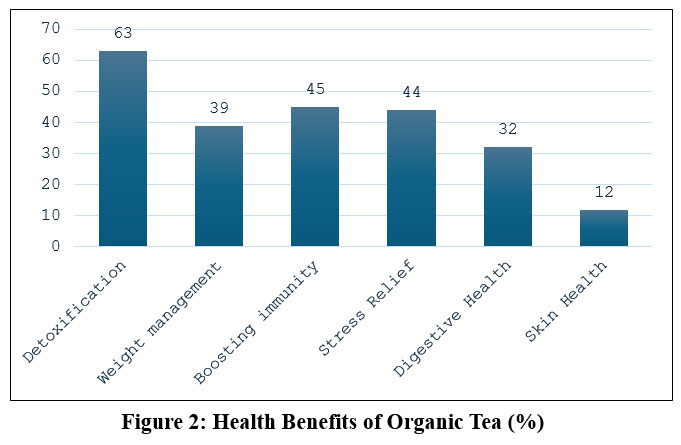 | Figure 2: Health Benefits of Organic Tea (%)
|
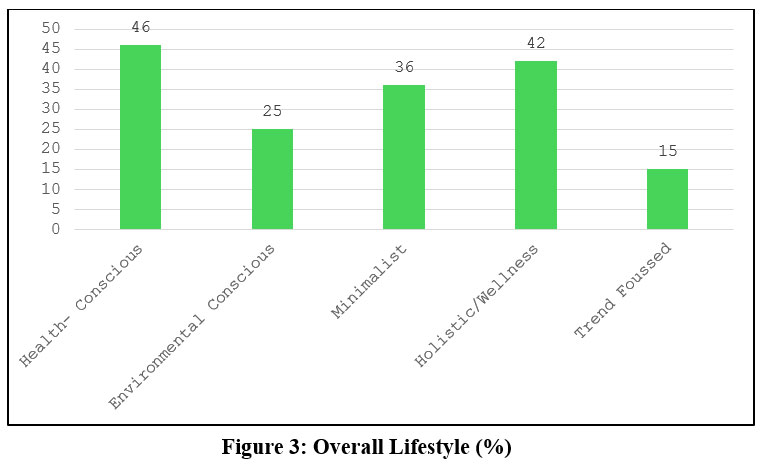 | Figure 3: Overall Lifestyle (%).
|
Lifestyle orientation of respondents as depicted in Figure 3 indicates that 46% of respondents adapt to health consciousness leading where they seem to align physical well-being with organic tea consumption. 42% of respondents view organic tea as part of a balanced wellness-centered lifestyle. A sizeable portion of respondents 36% have a minimalist appeal to organic tea for seeking products maybe with natural ingredients. Environmental consciousness influences 25% of respondents reflecting concern for sustainable and ecofriendly practices. Trend-focused lifestyle is the least prioritized with 15% of respondents.
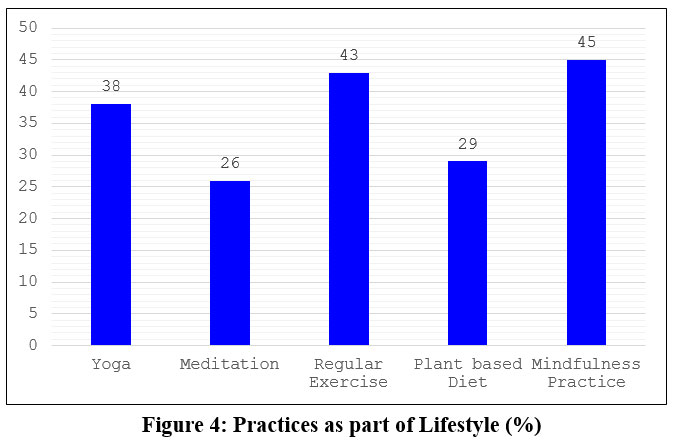 | Figure 4: Practices as part of Lifestyle (%)
|
Figure 4 depicts respondents' practices followed as part of their lifestyle. 45% of respondents believe in mindfulness practices as they focus on mental clarity and stress reduction. There is widespread commitment to physical health and fitness as 43% of respondents practice regular exercises. Yoga practitioners are 38% of respondents to provide a blend of physical and mental wellness. A moderate of 29% of respondents depicts interest in a plant-based diet with a trend moving toward organic consumption. Meditation practices are with few 26% of respondents as compared to another wellness approach of consumers.
Respondents prioritize organic tea brand selection as indicated in Figure 5 where taste and quality are important factors showing 63% and 62% of responses driving consumers' choice or likely attributes in organic tea experience. Brand trust indicating reliability and credibility is an important factor valued by 44% of respondents. Ethical sourcing shows a moderate 27% response while transparency of sourcing and production shows a 17% response suggesting that it ranks lower than quality and taste. Innovation gives the least appeal in resonating with brand identity.
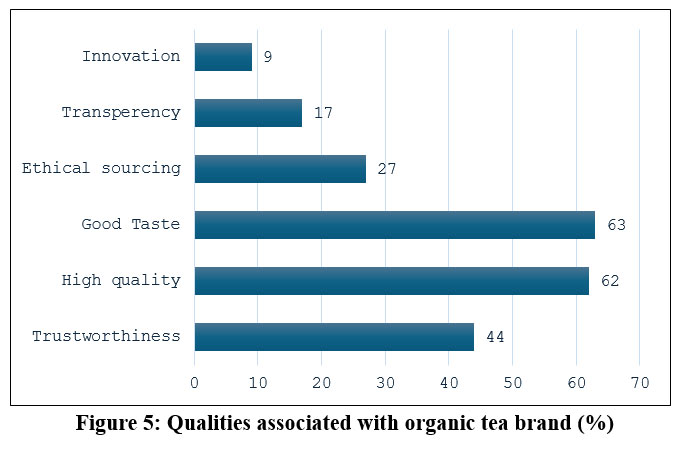 | Figure 5: Qualities associated with organic tea brand (%)
|
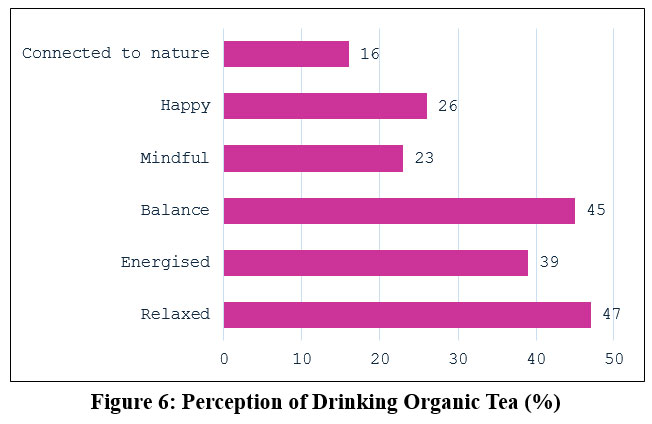 | Figure 6: Perception of Drinking Organic Tea (%)
|
Figure 6 highlights respondents' feelings of emotional and sensory experiences on consuming organic tea. Relaxation gives a primary appeal with 47% of respondents feeling due to the calming effects associated with tea. Organic tea consumption leads to a sense of well-being and alertness as 45% and 39% of the responses show it as a balanced and energized beverage. There is a moderate association between mindfulness and mental clarity in 23% of responses. Moderate joy or contentment happiness is felt by 26% of the respondents. The least common feeling experienced by respondents is a connection to nature with 16% response. Thus, organic tea resonates more with calmness and a revitalizing experience.
Table 3: Hypothesis Testing
Mann-Whitney U Test | ||
Null Hypothesis | Significance | Decision |
HO1: The mean distribution of health importance is the same across categories of gender | 0.894 | Retain the null hypothesis |
HO2: The mean distribution of organic tea to support sustainable and eco-friendly farming practices is the same across categories of gender | 0.502 | Retain the null hypothesis |
HO3: The mean distribution of consuming organic tea due to environmental concerns is the same across categories of gender | 0.089 | Retain the null hypothesis |
HO4: The mean distribution of willingness to pay more for organic tea to get higher quality is the same across categories of gender | 0.856 | Retain the null hypothesis |
HO5: The mean distribution of importance given to packaging and labeling in purchasing organic tea is the same across categories of gender | 0.775 | Retain the null hypothesis |
Kruskal-Wallis Test | ||
Null Hypothesis | Significance | Decision |
HO1: The mean distribution of health importance is the same across categories of occupation | 0.871 | Retain the null hypothesis |
HO2: The mean distribution of choosing organic tea to support sustainable and eco-friendly farming practices is the same across categories of occupation | 0.433 | Retain the null hypothesis |
HO3: The mean distribution of consuming organic tea due to environmental concerns is the same across categories of occupation | 0.805 | Retain the null hypothesis |
HO4: The mean distribution of willingness to pay more for organic tea to get higher quality is the same across categories of occupation | 0.06 | Retain the null hypothesis |
HO5: The mean distribution of importance given to packaging and labeling in purchasing organic tea is the same across categories of occupation | 0.24 | Retain the null hypothesis |
HO6: The mean distribution of health importance is the same across categories of Annual Household Income. | 0.156 | Retain the null hypothesis. |
HO7: The mean distribution of choosing organic tea to support sustainable and eco-friendly farming practices is the same across categories of Annual Household Income. | 0.25 | Retain the null hypothesis. |
HO8: The mean distribution of consuming organic tea due to environmental concerns is the same across categories of annual Household Income. | 0.251 | Retain the null hypothesis. |
HO9: The mean distribution of willingness to pay more for organic tea to get higher quality is the same across categories of Annual Household Income. | 0.079 | Retain the null hypothesis. |
H10O: The mean distribution of importance given to packaging and labeling in purchasing organic tea is the same across categories of Annual Household Income. | 0.06 | Retain the null hypothesis. |
H11O: The mean distribution of health importance is the same across categories of Age. | 0.283 | Retain the null hypothesis. |
H12O: The mean distribution of organic tea to support sustainable and eco-friendly farming practices is the same across categories of Age. | 0.257 | Retain the null hypothesis. |
H13O: The mean distribution of consuming organic tea due to environmental concerns is the same across categories of Age. | 0.26 | Retain the null hypothesis. |
H14O: The mean distribution of willingness to pay more for organic tea to get higher quality is the same across categories of Age. | 0.026 | Reject the null hypothesis. |
H15O: The mean distribution of importance given to packaging and labeling in purchasing organic tea is the same across categories of Age. | 0.03 | Reject the null hypothesis |
Chi-Square Test | ||
Null Hypothesis | Significance | Decision |
H16O: The frequency of consuming organic tea is independent of age. | 0.019 | Reject the null hypothesis |
H17O: The frequency of consuming organic tea is independent of occupation. | 0.027 | Reject the null hypothesis |
H18O: The frequency of consuming organic tea is independent of Annual Income. | 0.008 | Reject the null hypothesis |
H19O: Consumption of organic tea is independent of health-conscious consumers. | 0.00 | Reject the null hypothesis |
Findings from Table 3 of the hypothesis prove that the mean difference test results of different aspects including Health Importance, Sustainability, Environment, Willingness to Pay Extra, Packaging & Labelling did not reveal any significant difference due to gender difference. From the hypothesis testing, it is agreed that gender does not play a significant role in determining the drivers of organic tea consumption among the respondents. This implies that men and women are equally motivated to consume organic tea and have similar attitudes towards this product regarding the perceived health importance of the product, support for sustainable and organic farming methods, environmental issues, willingness to pay a premium for the product due to the way it is processed, packaged and labeled. Therefore, marketing communication for organic tea brands could directly communicate these shared values and there was no need for the organic tea brands to segment their messages based on gender. Stating such attributes as health-related benefits, sustainability, longer product quality, and eco-friendly packaging should tally well with both genders in the target market. Findings indicate that people from all sorts of professions and annual household incomes have similar goals concerning the motivation for choosing organic tea where variables such as health importance, support of sustainable farming, environmental issues, willingness to pay for higher quality, and their packaging and labeling concerns. Annual household income does not play a significant role in selecting organic tea. Findings imply that customers' age has an impact on the perceived quality and packaging attributes of organic tea. Hypothesis findings indicate that some age groups potentially consume organic tea more frequently. Individuals in different occupations are more inclined towards consuming organic tea. The frequency of consuming organic tea depends on income levels implying that consumption habits are influenced by factors of affordability and spending preferences. Health is a significant driver as findings suggest that health-conscious consumers consume organic tea frequently.
Table 4: Hypothesis Testing (AVOVA)
ANOVA | |||||
|---|---|---|---|---|---|
To what extent do you agree with the following statement: "I am willing to pay more for organic tea because I believe it is of higher quality." | |||||
Sum of Squares | Df | Mean Square | F | Sig. | |
Between Groups | 5.749 | 3 | 1.916 | 1.993 | .118 |
Within Groups | 121.143 | 126 | .961 | ||
Total | 126.892 | 129 | |||
H20O: The mean perception of paying more for a higher quality of organic tea is the same across different income levels.
H201: The mean perception of paying more for a higher quality of organic tea is different across different income levels.
Based on ANOVA Table 4 p value is obtained as (.118) we conclude that the mean perception of paying more for higher quality organic tea is the same across different income levels. It indicates that a consistent attitude is maintained on paying a premium for quality organic tea with varying income levels.
Discussion
There are many managerial implications as
Product Positioning and Marketing: Freshness or purity aspects along with the perceived medicinal value of the different tea products such as as being a detox food, containing additives & preservatives, or being a stress buster might appeal to the core consumer group and possibly to all consumer groups. As for the perceived importance of the values concerned, marketing messages can be sent without gender segmentation as men and women exhibit no significant differences. Also, marketing organic tea as a natural and relaxing drink corresponds with the emotional attribute that consumers are in search of, and thus suitable for habitual and moderate tea consumers.
Retail Strategy and Accessibility: This means that there is a need to call for grocery and online stores to guarantee that consumers find organic tea easily. Working with the key retail channels and improving the website position would attract a wider population. E-commerce, particularly local market presence may appeal to consumers who prefer fresh produce products and those who are inclined to buy from local farmers while direct from the farm may be appealing to consumers who value farm-fresh products.
Branding and Packaging: The three key needs should be quality, taste/feel, and brand, and these need to be communicated effectively in the branding/marketing packaging. Also, the taste and appearance of different products, such as quality packaging and clearer supply chain procedures, can better attract younger consumers, and the use of the statements concerning ethical sourcing and sustainable practices can address environmental and physically healthy segments.
Product Development and Pricing: It means that consumers' willingness to pay for superior quality is not influenced by their income level, which provides brands proof point on having premium price points, having assurance of quality being a priority. Such changes can include value addition through health-enhanced flavors or supplements that can go well with current fashionable immunity boosting and detoxification.
Customer Engagement: Due to the customer's interest in things like mindfulness and holistic health, interacting with customers through wellness-related activities or a notion linking the consumption of organic tea to mindfulness, relaxation, and wellness. To solidify this brand image, it would be beneficial to partner with influencers whose niches are wellness and mindfulness.
Conclusion
Hence the study concludes various points as it provides some critical information about the consumers and their reasons for shifting to organic tea. Depending on the type, green tea is preferred to Black tea. The third major channel for organic tea is supermarkets Since most organic tea is bought for convenience and easy access, the supermarket is a primary source of organic tea. Purity and Relationships are the two most common uses of organic tea with detoxifying being the most cited reason followed by enhanced immunity. Moreover, the targeted audience is partially or wholly interested in health-oriented activities like meditation, physical exercises, and yoga, and supports organic tea consumption. The main reasons for brand loyalty hence brand choice can be categorized into quality & taste, trust & ethical considerations though the latter is somewhat less dominant. The respondents also reported improvement in mood as some of the emotional attributes of those who take organic tea; relaxation balance and energy enhancements while some feel connected to nature through tea.
The hypothesis testing results show that attitudes and motivations toward organic tea consumption do not differ between males and females, so there cannot be a general assumption that male consumers may have different motivations than females for consuming genetically modified foods. Income group/occupation also bears no relationship with the purchase intentions for organic tea, although health-conscious and environmentally friendly were the same across the respondent categories. However, attitudes regarding perceived quality and packaging preferences are also driven by age; some age groups more frequently consume organic tea. Further, frequency of consumption depends on income level probably due to cost influence while health consciousness is still a key driver to frequent consumption.
Acknowledgement
It brings me great pleasure to thank Chetana’s Institute of Management and Research Library for furnishing the requisite resources and amenities that facilitated the completion of this research. For their specific support and guidance during the research, I would like to express my sincere gratitude to management support and all faculty colleagues for their tremendous contributions which have impacted my academic success.
Funding Sources
The author received no financial support for the research, authorship, and/or publication of this article.
Conflict of Interest
The author declares no conflict of interest.
Data Availability Statement
This statement does not apply to this article
Ethics Statement
This research did not involve human participants, animal subjects, or any material that requires ethical approval.
Informed Consent Statement
This study did not involve human participants, and therefore, informed consent was not required.
Permission to reproduce material from other sources
For Figures 1 to 6
Figure [1 to 6] has been reproduced with permission from [Shalini Kakkar)], [Psychographic Determinants of Organic Tea Consumption: An Empirical Study], [Journal/Book Title(NA)], [Publisher(NA)], [Year of Publication(NA)], [DOI or URL(NA)]. Permission granted by [Copyright Holder's Name/Agency(NA)].
For Tables: 1 to 4
Table [1 to 4 ] has been reproduced with permission from [Shalini Kakkar)], [Psychographic Determinants of Organic Tea Consumption: An Empirical Study], [Journal/Book Title(NA)], [Publisher(NA)], [Year of Publication(NA)], [DOI or URL(NA)]. Permission granted by [Copyright Holder's Name/Agency(NA)]
For Text Excerpts
[Excerpt] has been reprinted with permission from [[Shalini Kakkar)], [Psychographic Determinants of Organic Tea Consumption: An Empirical Study], [Journal/Book Title(NA)], [Publisher(NA)], [Year of Publication(NA)], [DOI or URL(NA)]. Permission granted by [Copyright Holder's Name/Agency(NA)].
Author Contributions
The sole author was responsible for the conceptualization, methodology, data collection, analysis, writing, and final approval of the manuscript.
References
- Agriculture and Agri-Food Canada. (2022). Organic Tea Trends In The United States: Focus On Top Five Markets (Health And Wellness Series). Government Of Canada. https://agriculture. canada.ca/en/international-trade/market-intelligence/reports/health-and-wellness-series organic-tea-trends-united-states-focus-top-five-markets
- Ajzen, I. (2006). Constructing A Theory of Planned Behavior Questionnaire: Conceptual and Methodological Considerations. Retrieved September 15, 2015.
- Attri, R. and Bairagi, R (2023), "Marketing Organic Products: Challenges And Opportunities For A Sustainable Living", Vol. 3No.1. https://doi.org/10.1108/EEMCS-09-2022-0321
CrossRef - Bagchi, A.; Ghosh, B.C.; Swain, D.K.; Bera, N. Organic Farming Practice for Quality Improvement Of Tea And Its Anti-Parkinsonism Effect On Health Defence. J. Phys. Chem. Biophys. 2015, 5, 2161.
CrossRef - Chakrabarti, S., & Baisya, R. K. (2007). Purchase Motivations and Attitudes of Organic Food Buyers. Decision, 34(1), 1-22.
CrossRef - Chen, Y. (2011). Green Organizational Identity: Sources And Consequence. Management Decision, 49(3), 384-404.
CrossRef - Dang, V.T., Wang, J., Nguyen, H.V., Nguyen, Q.H. and Nguyen, N. (2022), "A Moderated Mediation Study Of Consumer Extrinsic Motivation And CSR Beliefs Towards Organic Drinking Products In An Emerging Economy", British Food Journal, Vol. 124 No. 4, pp. 1103-1123. https://doi.org/10.1108/BFJ-12-2020-1096
CrossRef - DaSilva Pinto, M. Tea: A New Perspective on Health Benefits. Food Res. Int. 2013, 53, 558–567.
CrossRef - Doanh, N.K., Quynh, N.N. and Pham, T.T.L. (2022), "Going Organic Or Staying Traditionalistic? The Role Of Agriculture Information System", International Journal of Social Economics, Vol. 49 No. 10, pp. 1458-1478. https://doi.org/10.1108/IJSE-11-2021-0720
CrossRef - Drejerska, N., Sobczak, W., Go??biewski, J. and Gierula, W.A. (2021), "Does Organic Mean Health For Consumers? Selected Issues of Organic Food Market", British Food Journal, Vol. 123 No. 8, pp. 2622-2640. https://doi.org/10.1108/BFJ-12-2020-1175
CrossRef - Fortune Business Insights. (2023). Market research report: Bubble Tea Market [IMPACT COVID-19] Status, Growth Opportunity, Size, Trends, Key Industry Outlook 2022–2030. https://www.fortunebusinessinsights.com/industry-reports/segmentation/bubble-tea market-101564
- Global Market Report. Sustainable Commodities Marketplace Series 2024 Available online: Global Market Report: Tea Prices And Sustainability (iisd.Org).
- Gandhi, A.V. (2021), "Studying Green Consumer Behavior Through Multiple Lenses In A Developing Country", Smart and Sustainable Built Environment, Vol. 10 No. 2, pp. 274-292. https://doi.org/10.1108/SASBE-01-2019-0011
CrossRef - Hazra, N.G. Organic Tea: Cultivation and Marketing; International Book Distributors: Dehra Dun, India, 2006.
- Ho, C.T.; Lin, J.K.; Shahidi, F. Tea, and Tea Products: Chemistry and Health-Promoting Properties; CRC Press: London, UK, 2008.
CrossRef - Jensen, J.D.; Christensen, T.; Denver, S.; Ditlevsen, K.; Lassen, J.; Teuber, R. Heterogeneity In Consumers’ Perceptions And Demand For Local (Organic) Food Products. Food Qual. Prefer. 2019, 73, 255–265.
CrossRef - Legeay, S.; Rodier, M.; Fillon, L.; Faure, S.; Clere, N. Epigallocatechin gallate: A Review of Its Beneficial Properties to Prevent Metabolic Syndrome. Nutrients 2015, 7, 5443–5468.
CrossRef - Organic Tea Market Analysis - China, India, Germany, UK, US - Size and Forecast 2024-2028 (technavio.com)
- ORG MARG. (2002). Study on Organic India. Data on ûle 2002. New Delhi: ACNielsen ORG MARG Research Limited. Retrieved from www.org-marg.com.
- Padel, S., & Foster, C. (2005). “Exploring The Gap Between Attitudes And Behavior: Understanding Why Consumers Buy Or Do Not Buy Organic Food”. British Food Journal, 107(8), 606 - 625.
CrossRef - Rothenberg,D.O.;Zhang,L. Mechanisms Underlying the Anti-Depressive Effects of Regular Tea Consumption. Nutrients 2019, 11, 1361.
CrossRef - Storozhuk, M. (2022). COVID-19 And Per Capita Green Tea Consumption: Update. medRxiv. https://www.medrxiv.org/content/ 10.1101/2022.06.06.22276060v1
CrossRef - Sumi, R.S.; Kabir, G. Factors Affecting the Buying Intention Of Organic Tea Consumers Of Bangladesh. J. Open Innov. Technol. Mark. Complex. 2018, 4, 24.
CrossRef

This work is licensed under a Creative Commons Attribution 4.0 International License.